Shigeru Akagi
main character
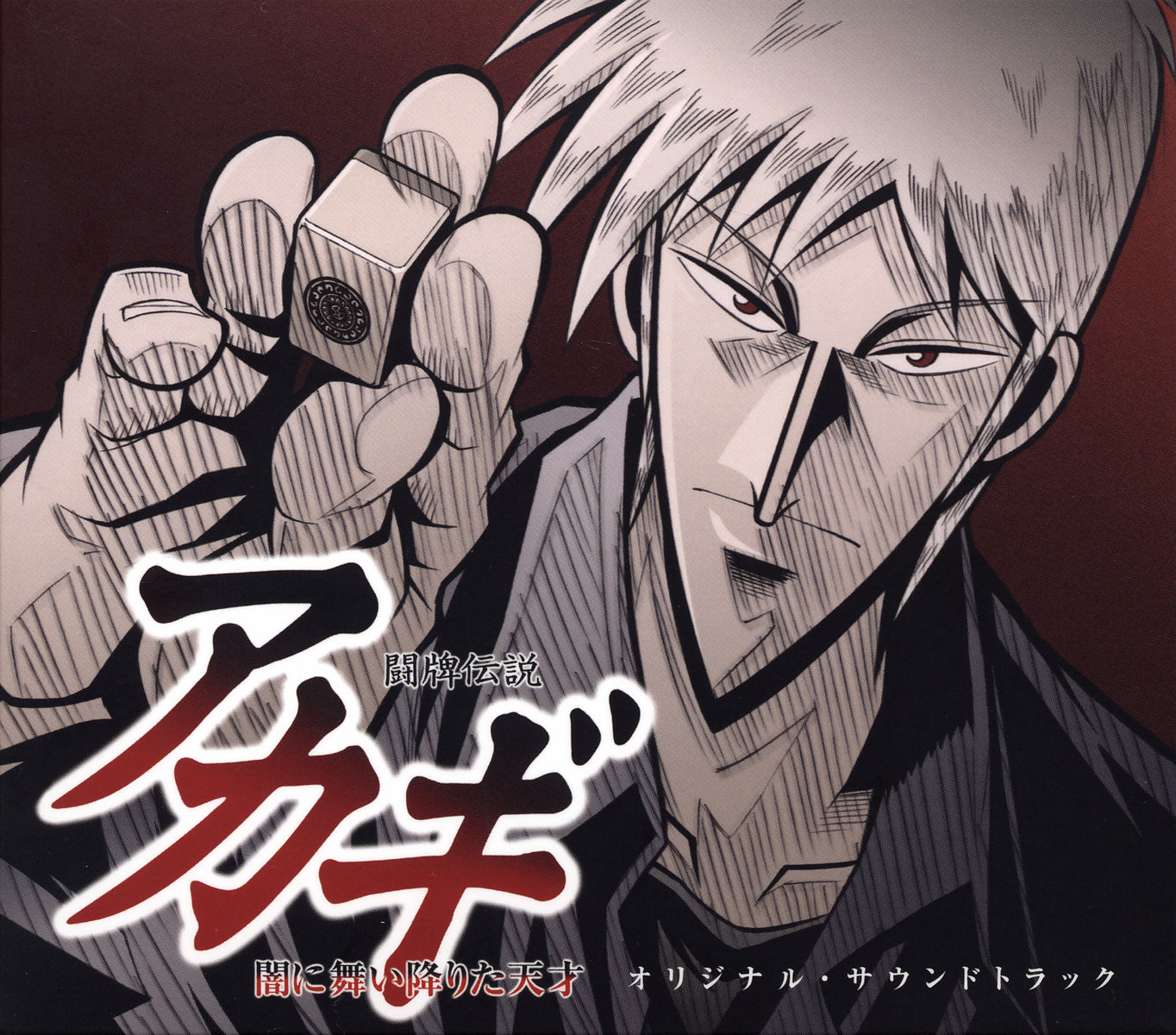


While mahjong is a game that is often played with family and friends, it is also a game that is played in the darkest corners of society. Nangou is a compulsive gambler who has accumulated a debt of over three million yen. In a last-ditch attempt to clear his record, he decides to wager his life on a game of mahjong with the mafia. Unfortunately, as the game progresses, Nangou only moves further from the prize and closer to death. When all hope seems lost, the game parlor is suddenly intruded upon by Shigeru Akagi, a young boy on the run from the police. Desperate to turn the game around, Nangou hands the game over to Akagi after teaching him a few of the rules. The mafia can only smirk as Akagi sits down to play. However, they soon come to learn that Akagi is a natural-born gambler. An imposing figure who does not fear death. One who is destined to become a legend. (Source: MAL Rewrite)
Akagi has been well received, with an average AniList score of 77/100 — 65% of 10,567 ratings are 8/10 or higher.
It ranks #6 highest-rated anime of 2005, and #17 most popular anime of 2005, and #4 highest-rated anime of Fall 2005 on AniList.
Of the 17.4K AniList users who started it, 4.9% dropped it, so it is rarely abandoned; 13.8K have finished it.
At about 9 h 58 min in total, plan on one to two weeks at a couple of episodes a day.
Best for viewers who enjoy Psychological, Sports, Thriller — especially gambling, mahjong, noir, seinen.
A streaming link is not listed for this title yet.
26 episodes are listed.
Theme data from AnimeThemes.moe.
Akagi has 26 episodes of about 23 minutes each, roughly 9 h 58 min in total.
About 9 h 58 min back to back. At two episodes a day it takes 13 days; at one hour a day, about 10 days.
Yes. Akagi has finished airing — the final episode aired March 28, 2006.
No sequel is listed for Akagi as of October 2026. You can continue the story in the original manga.
Yes. Akagi adapts the manga by Nobuyuki Fukumoto.
Akagi was animated by MADHOUSE and directed by Yuuzou Satou.
The opening, "Nantoka Nare", is performed by an uncredited artist.